Updated October 2026
Sunbed hogging is the practice of claiming a pool or beach lounger with a towel or personal item and then leaving it unused for long periods, so other guests cannot sit there. It looks like a guest manners problem. In practice it is an allocation problem, and allocation is the hotel's job, not the guests'.
Disclosure: this article is published by a company that sells lounger management software, so we have a commercial interest in the subject; details are in the note at the end. Where other approaches win, we say so. Written for hotel general managers, owners and front office managers at resort properties in the EU and the wider Mediterranean.
Defined term: sunbed hogging. Sunbed hogging (the everyday behaviour behind the sunbed wars, also called towel wars, the dawn dash or lounger reserving) is the occupation of a shared lounger by an object rather than a person, for longer than the venue intends, with the effect that available seating on a pool deck or beach appears full while being largely empty.
Here is the question this guide keeps returning to, because it is the one your pool attendant cannot answer at 10:15 on a Tuesday in August: "who is that lounger actually for right now?"
What exactly counts as sunbed hogging?
Sunbed hogging is any claim on a lounger that outlives the claimant's presence by more than the venue's stated grace period. The towel is just the token. A book, a bag or an inflatable flamingo does the same job. The defining feature is absence: the bed is held but nobody is using it, and nobody can tell for how long.
Most hotels already accept short absences. A swim, a coffee, a toilet break, a child who needs rescuing from the slide queue: none of that is hogging, and a policy that treats it as hogging will generate more complaints than it prevents.
The line is crossed when the claim is made "in advance of use" rather than "during use". A guest who lays a towel at 06:40 and walks to breakfast has not paused their lounger. They have reserved it, for free, with no expiry, using a reservation system that the hotel did not design and cannot see.
That last point is the useful reframe. Every pool deck already runs a reservation system. It is made of cotton.
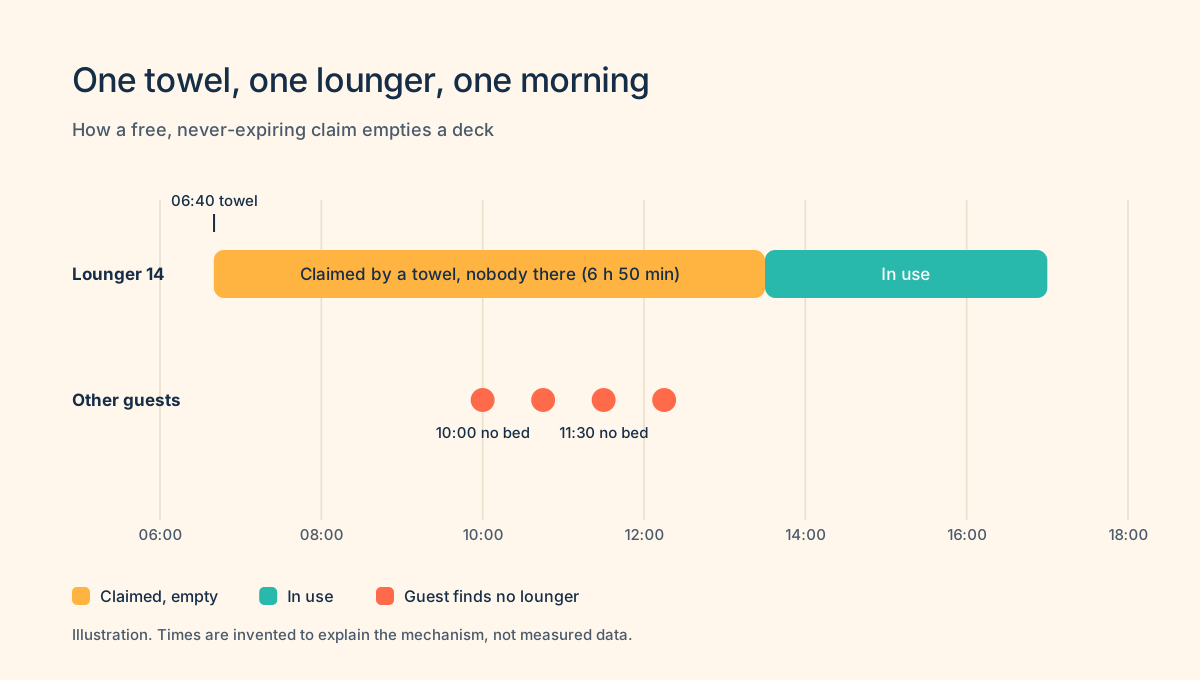
Illustration of a single towel-reserved lounger. Times are invented for explanation, not measured data.
How much pressure is the Mediterranean pool deck actually under?
Pressure on resort pool decks is rising because demand is rising faster than anyone adds loungers. Spain received a record number of international visitors in 2025, the EU recorded record accommodation nights, and global arrivals grew again. A pool deck is a fixed asset; the number of people who want to lie on it at 11:00 is not.
The scale is easy to underestimate from inside one property. Spain received 96.8 million international tourists in 2025, a record and 3.2% more than in 2024, according to INE, the Spanish National Statistics Institute. The same release places the Balearic Islands as the second most visited Spanish region, after Catalonia.
None of those numbers mention loungers, and that is the point. Rooms get revenue-managed. Restaurant covers get booked. The pool deck, which is often the first thing a guest photographs and the last thing they complain about, is usually managed by whoever gets up earliest.
We have looked at how many loungers resorts actually carry per room in our companion piece on sunbeds per room. The short version: our working estimate is roughly half a lounger per room at a typical Mediterranean resort. That is an estimate from aerial imagery and published room counts, not published inventory data, but it explains why a small amount of hogging empties a deck fast.
Why do towel policies keep failing?
Towel policies fail because they depend on enforcement by staff who have other jobs, against guests who will be at breakfast in the same room tomorrow. A rule that says "towels removed after 30 minutes" needs someone to notice the start time, remember it, and then confront a stranger's belongings. That is three tasks nobody is rostered for.
The policies themselves are usually sensible. Fred. Olsen Cruise Lines states that towels or belongings left unattended for 30 minutes or longer may be removed by staff, which is roughly the norm at sea and on land. The trouble is not the number. It is the clock.
Nobody on your deck knows when the towel arrived. A towel placed at 06:40 and a towel placed at 10:05 look identical at 10:20. So the attendant either removes both (and upsets the guest who went for a swim) or removes neither (and upsets the twelve guests standing by the bar holding their own towels like flags of surrender).
Public authorities have run into the same wall on beaches. Calpe, on the Costa Blanca, can remove beach items set up before 9 a.m. and fine owners €250, and items left unattended for more than three hours may also be removed, as reported by CNN via CTV News. Fines work best where there is a police force to issue them. Your pool has a lifeguard who would rather not.
Police in Calvià and Andratx have started using drones to check whether towel-claimed sunbeds are actually in use, and fines of €50 to €300 apply in some areas, according to the Majorca Daily Bulletin. Your pool, mercifully, is not yet patrolled from the air.
So ask the question again, standing on your own deck mid-morning: "who is that lounger actually for right now?" If the honest answer is "we have no way of knowing", the policy is decorative.
Running a pool deck that fills before breakfast? Book a 20-minute deck review.
What did the Hanover court ruling change for hotels?
A German district court has now treated towel-blocked loungers as a defect in a package holiday. The ruling is against a tour operator rather than a hotel, but it moves the sunbed wars from guest etiquette into service quality, and tour operators tend to pass service-quality expectations straight down to the properties they contract.
In a judgment reported in May 2026, the district court in Hanover found a travel defect in a €7,186 family package holiday to Kos because towel-reserved loungers were effectively unusable, setting the total refund at €986.70, of which the tour operator had already paid €350, as reported by t-online (dpa). The judges said the operator should have ensured a reasonable ratio of loungers to guests, even though it did not run the resort.
The resort had 400 loungers and signs banning reservations that were not enforced, according to The Portugal News. The court took the view that the operator should have intervened, and that comparable cases can also amount to a travel defect, as reported by Travelbook.
Two cautions before anyone rewrites their contracts. These are first-instance decisions in one country, and the amounts are modest. But the logic matters more than the sum. The court did not say "guests behaved badly". It said, in effect, the arrangement for allocating loungers did not work. That is an operational finding, and operations is your department.
Nor was it the first such case. In 2023 the same Hanover district court (553 C 5141/23) allowed a 15% daily price reduction for the days after a family complained about towel-blocked loungers, and said guests cannot be expected to remove other people's towels themselves, according to jura.cc. Law firm commentary on the 2026 judgment (527 C 9826/25, 20 April 2026) notes a 15% reduction per affected day and stresses that guests must report the problem promptly so the operator can fix it, according to ra-kotz.de.
The Majorca Daily Bulletin warned that hotels and tour operators across Mallorca and Spain could face similar claims this summer, and noted that at least one operator already sells pre-bookable pool spots for a fee.
Is sunbed hogging a guest problem or a design problem?
Sunbed hogging is a rational response to a badly designed system. When claiming a lounger costs nothing, holding it costs nothing, and losing it costs a morning, the sensible move is to claim early and hold long. Guests are not villains. They are responding correctly to incentives the deck accidentally created.
Look at it the way a revenue manager would. A towel at dawn is a free option on the best seat in the house, with no expiry and no penalty. The only cost is an early alarm, and holiday guests are, astonishingly, willing to pay it.
This is why stern laminated notices rarely move the needle. Nobody puts up a sign saying "please do not book more rooms than you need".
The reframe for a general manager is simple. You do not need better guests. You need a claim that expires, an arrival that can be checked, and a release that happens without a staff member having to be brave. Which brings us back, a third time, to the question that a working system has to answer automatically: "who is that lounger actually for right now?"
What does a fair lounger system actually need to do?
A fair lounger system needs four properties. A claim must be visible and attributable. It must expire unless the guest arrives within a set window. Arrival must be confirmed at the lounger, not at reception. Unclaimed or abandoned beds must return to everyone automatically, without a staff member having to judge anyone's towel.
Each property removes one of the reasons towel policies fail.
- Visible claims mean an attendant can see that bed 14 was claimed at 09:52 by a guest who is now 20 minutes into a 30-minute window. The argument about "when did that towel arrive" disappears.
- Expiring claims turn the free option into a short one. Guests can still plan their morning, but they cannot plan it at everyone else's expense.
- Arrival at the lounger stops people confirming from the breakfast table. The proof of presence has to happen where the presence is supposed to be.
- Automatic release is the part that protects your staff. Nobody has to remove a stranger's belongings. The bed simply becomes available again, and the guest is told why.
Notice what is missing from that list: cameras, guest tracking and fines. A fair system is about the furniture, not about surveilling people, which is worth remembering now that some Mallorca councils have reached for drones. That distinction becomes important once you look at privacy law, which we cover in our piece on pool deck privacy and GDPR.
There is also a group dimension that most policies ignore. A family of five does not want five loungers. It wants five loungers next to each other, which is a different and harder allocation problem. Any plan of your deck only helps if it is updated when housekeeping moves four beds.
What should a hotel do before next season?
Start with evidence, not software. Count claimed-but-empty loungers at fixed times for two weeks, decide a written policy with an arrival window and a grace period for short absences, give staff a route for guests without phones, and make sure guests hear the rules before arrival. Then choose tools, if you still need them.
Hotels are already experimenting. Iberostar Selection Sábila in Tenerife lets guests reserve loungers in an app up to 48 hours ahead, with unused reservations lapsing at 10:30; Amàre Beach Hotel Ibiza removes items left unattended for 30 minutes; and some hotels in Cyprus assign loungers at check-in, according to Hogapage.
Those examples cover the whole spectrum, from no technology to an app, and each one answers the same question in a different way: "who is that lounger actually for right now?" Pick the answer that fits your deck, not the one that fits a brochure.
Two practical points from the court cases are worth building into the procedure. Guests who complain should have a clear place to report the problem, because a prompt report is what gives the hotel a chance to fix it. And staff should never expect guests to clear other guests' towels themselves; both Hanover rulings treat that as an unreasonable ask.
Where a small boutique pool with ten loungers and one attentive host is concerned, a friendly conversation probably beats any system. And a property that is genuinely short of loungers needs more loungers first. Allocation makes scarce inventory fair. It does not make it bigger.
The questions below come up in almost every conversation with general managers, owners and front office teams. Each answer is short and self-contained, and none of them requires you to buy anything. Where an answer depends on local law or your contracts, check it with your own advisers before acting.
Important information. This article is general information for hospitality operators. It is not legal, data-protection, tax or financial advice, and it does not promise any operational or commercial result. Court decisions cited are first-instance German rulings reported in the press and in legal commentary; they are not binding law across the EU. Figures are linked to their original sources or clearly labelled as estimates or illustrations. Seek advice from a suitably qualified professional before making decisions for your property.
About SunDibs. SunDibs is a patent-pending lounger management platform for hotel pools, resorts and beach clubs. Guests claim a lounger, confirm at the lounger within a set window, and unconfirmed beds return to everyone, with no cameras and no tracking of guests. It can start as software only. See how it would work on your deck.
Common questions
- Is sunbed hogging illegal?
- Reserving a hotel pool lounger is not generally illegal; it is governed by the hotel's own rules. Some municipalities regulate public beaches, and Calpe, for example, can fine owners €250 for beach items placed before 9 a.m., as reported by [CNN via CTV News](https://guelph.ctvnews.ca/lifestyle/article/spanish-town-to-fine-tourists-for-hogging-beach-spots). On a private pool deck, the hotel sets and enforces the policy.
- Why do guests reserve loungers so early?
- Because the system rewards it. If claiming is free and never expires, claiming early is the rational choice, and once a few guests do it, everyone learns that waiting means losing. Changing the incentive works better than appealing to manners.
- What is a reasonable unattended time limit?
- Thirty minutes is a common published standard, used for example by [Fred. Olsen Cruise Lines](https://www.fredolsencruises.com/faqs/on-board/am-i-able-to-reserve-a-sunbed). Many families find it tight because of food queues and children. Whatever number you choose, it only works if staff can actually see when the clock started.
- Can staff remove guests' towels?
- Most hotels reserve the right to in their published rules, but removal is where conflict happens. Staff should follow a clear, written procedure: tag first, store items safely, record the time. A system that releases the bed automatically avoids the confrontation entirely.
- Does the Hanover ruling apply to my hotel?
- It was one German first-instance decision against a tour operator, not a hotel, with a total refund of €986.70, of which €350 had already been paid, according to [t-online (dpa)](https://www.t-online.de/nachrichten/panorama/gesellschaft/id_101240254/nicht-genug-sonnenliegen-urlauber-erhaelt-geld-teils-zurueck.html). It is not binding law across the EU. Its practical effect is that tour operators may ask contracted hotels how loungers are allocated. Take advice on your own contracts.
- Will adding more loungers solve sunbed hogging?
- Only partly. If a deck is genuinely under-supplied, more loungers help. But hogging grows to fill the space available, because the incentive to claim early does not change. Allocation and capacity are separate problems and usually need separate fixes.
- Has any other court ruled on sunbed wars?
- Yes. A 2023 decision of the same Hanover district court (553 C 5141/23) also reduced the price by 15% per affected day after towel-blocked loungers went unenforced, according to [jura.cc](https://www.jura.cc/rechtstipps/mangelhaftigkeit-einer-pauschalreise-wegen-vielfach-reservierter-poolliegen/). Both are first-instance German rulings, not EU-wide law.
- Do lounger reservation systems discriminate against older guests?
- They can, if the only way to claim a bed is a smartphone. A fair system needs a front-desk or attendant route so staff can claim a lounger on a guest's behalf. Ask any vendor to demonstrate that route, not just describe it.
- Do lounger systems need cameras?
- No. Arrival can be confirmed at the lounger with a QR scan or an NFC tap. Article 35(3)(c) of the [GDPR](https://eur-lex.europa.eu/eli/reg/2016/679/oj) requires a data protection impact assessment for systematic monitoring of a publicly accessible area on a large scale, an obligation furniture-based systems usually avoid. Check the specifics with your data protection officer.
- Should premium loungers be paid?
- Many beach clubs already sell loungers and many hotels sell cabanas. A paid zone can work alongside free general seating, provided the free area remains genuinely usable. If the free deck is hogged, a paid zone can look like a penalty rather than an upgrade.
- How quickly can a hotel change its lounger policy?
- A rule change can happen within a day, but guests need to hear it before they arrive: in pre-arrival emails, at check-in and on the deck itself. Changing the rule mid-stay without notice tends to produce more complaints than the original problem.
- What should I measure before changing anything?
- Count towel-reserved but empty beds at fixed times for two weeks, log lounger complaints, and note staff time spent on disputes. Without a baseline you will not know whether any change worked. Avoid inventing benchmarks; your own deck is the only reliable comparison.
SunDibs is in its first pilot season. Where this page gives a number, it is either sourced or labelled as a target.